What is a daily log, and why does it decide arguments?
The daily log records who was on site, what got done and what stopped work. It is the first document anyone asks for in a dispute.
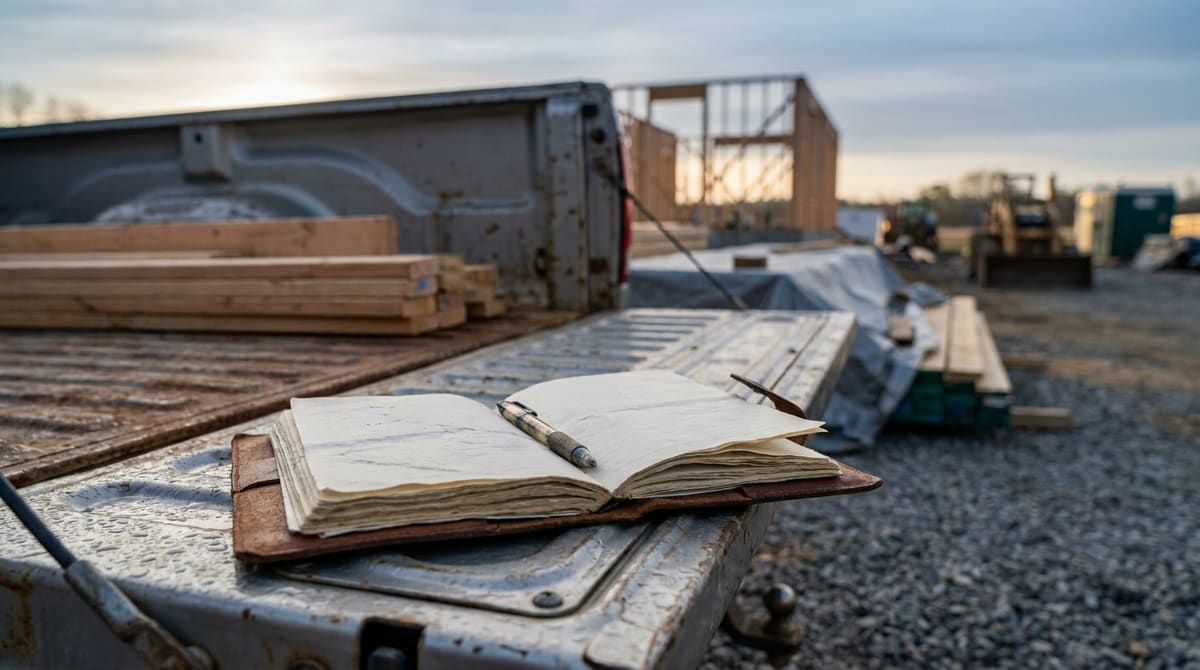
A daily log is the record of what actually happened on site on a given day: the weather, who was there, what got done, what stopped work and for how long, any safety incident, and anything delivered.
It is the least glamorous document on a construction project and the first one anybody asks for when there is a dispute.
What belongs in one
- The date, and one log per day per job. Two half-filled logs for the same Tuesday make the whole record untrustworthy.
- Weather and ground conditions. The basis of every weather-delay conversation.
- Who was on site — by company and trade, with how many people and how many hours. Head count times hours is man-hours, and man-hours are what a claim for acceleration or disruption is built from.
- What got done, plainly.
- What stopped work, and for how many hours. As a number.
- Deliveries, visitors and inspections. Who came, what arrived, what passed.
- Safety — incidents, near misses, the toolbox talk.
A month of "rained out most of the morning" proves nothing. "34 hours lost across nine days" is an argument, because it can be added up. Prose cannot be summed, and a schedule-extension claim stands or falls on a total.
Why the same day matters
A log written on the day is contemporaneous evidence and carries real weight. One written up a fortnight later from memory is a recollection, and it is weighed as one — however honest and however accurate it happens to be.
Which is why the practical design point is that filing a log has to take about a minute, standing in a driveway, on a phone. Anything that takes longer does not get done on the bad days — and the bad days are precisely the ones that end up mattering.
It protects the contractor more than the owner
Most schedule slips are not the builder's fault. They are late decisions, slow approvals, weather, or extras nobody counted days for. A contractor with a clean daily log can demonstrate that in five minutes. Without one, they simply look late — and looking late is expensive.
For an insurance job the log does double duty: it is the record of when the property was made safe, when it was dried out, and how long it was uninhabitable. All of which the carrier will eventually ask about.
Common questions
What goes in a construction daily log?
Date, weather and ground conditions, who was on site with head count and hours, what got done, what stopped work and for how many hours, deliveries, visitors, inspections and any safety matter.
Who writes the daily log?
Usually the superintendent or site lead. On a residential job it may be the contractor themselves. What matters more is that it is written the same day.
Are daily logs legally required?
Rarely by law, but contracts often require them, and they are the standard evidence in delay and disruption claims either way.
Keep all of this in one place
Punchlist360 is the punch list, the photographs, the budget and the insurance claim file for your build — so the record exists as a by-product of doing the work. $9.99 a month, cancel any time. Contractors you invite are free.
See how it works More guidesRead next
 The paper trail that wins construction disputesDisputes are decided by records, not by who is right. Here are the seven documents that settle almost every argument.
 How to hold a contractor to a schedule without a fightMost schedule disputes are really record disputes. Keep the right records and the conversation becomes short and factual.
 What is an RFI in construction, and how do you run them well?A request for information turns a question into a tracked, dated obligation with somebody's name on it. Here is how to write one that gets answered.
 Photographs: the difference between "I told you" and proofOn a construction job or an insurance claim, the photograph is the argument. Here is what to take, when, and how to keep it findable.